
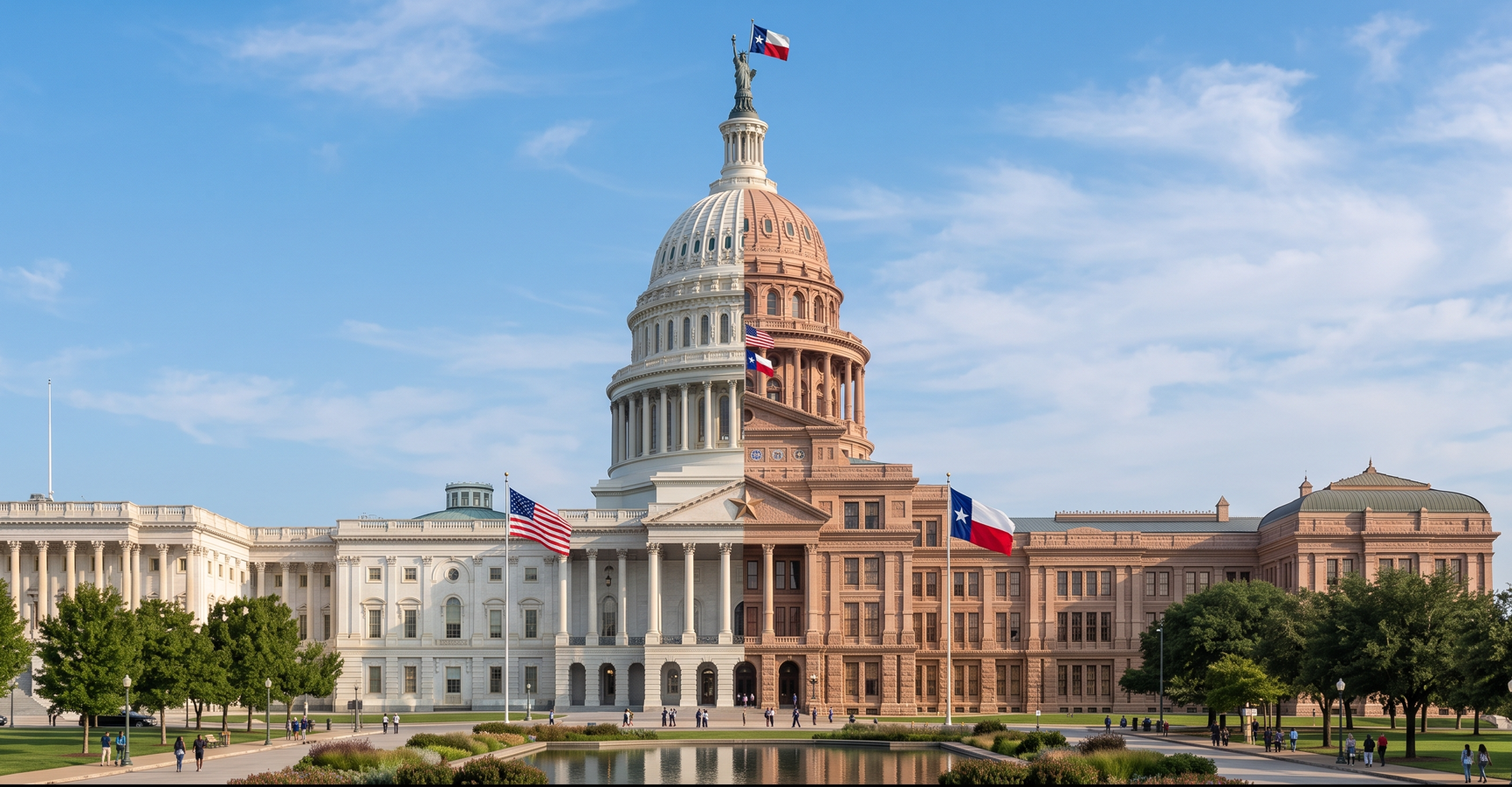
James Talarico is currently attempting a massive media makeover in his 2026 race against Ken Paxton for the U.S. Senate. Crisscrossing the state, the Democratic nominee is working aggressively to present himself as a reasonable, faith-driven voice for Texas. But a closer look at his actual legislative record, his policy platform, and his underlying political philosophy reveals a candidate whose ideology is deeply out of step with traditional Texas values.
Far from being a moderate unifier, conservatives warn that Talarico represents a Trojan horse—a candidate using religious rhetoric to mask a nationalized, far-left progressive agenda that threatens to dismantle the structural sovereignty and economic engine of the state.
The Abdication of Institutional Sovereignty
To understand the core conservative critique of Talarico, one must look at the fundamental purpose of the U.S. Senate. The Founding Fathers designed the upper chamber not simply as a secondary House of Representatives, but as the ultimate safeguard of federalism. A Senator’s constitutional duty is to represent the State of Texas as a sovereign institutional entity, defending its structural rights, borders, and autonomy against federal overreach.
Instead of embracing this duty to act as a defensive bulwark for the state, Talarico’s platform suggests he views the Senate merely as a vehicle to impose national progressive mandates on Texas.
This abdication of institutional sovereignty is most evident in his procedural stances:
- Eliminating the Filibuster: Talarico’s willingness to bypass or eliminate the legislative filibuster is viewed as a direct assault on the state’s structural defenses. The filibuster exists to prevent a slim, national majority from steamrolling regional interests. Removing it would allow coastal progressive majorities to impose sweeping federal laws on Texas without compromise.
- Federalizing Elections: His support for national voting rights legislation is not viewed by conservatives as protecting voters, but as stripping the State of Texas of its constitutional authority to administer its own elections and set its own security standards.
- Subordinating the Border: His past rhetoric describing the border as a “front porch” with a “welcome mat” fundamentally conflicts with Texas’s institutional need for strong, sovereign border enforcement. It signals a willingness to prioritize national progressive immigration theories over the immediate security and financial burden placed on the state apparatus.
Theological Cover for Radical Social Policy
Perhaps the most frequent conservative criticism of Talarico is his use of religious rhetoric to shield policies that erode the moral and cultural fabric of the state. While he frequently invokes his seminary background on the campaign trail, Republicans argue he is simply repackaging the radical left’s social agenda into a “liberal theology” designed to dismantle traditional values.
His tenure in the Texas House provides a clear roadmap of this strategy:
- Attacking Traditional Heritage: During the 2023 session, Talarico led the charge against Senate Bill 1515, which would have required public school classrooms to prominently display the Ten Commandments. He argued the mandate was “idolatrous” and “exclusionary,” a stance conservatives view as a direct rejection of the state’s foundational Judeo-Christian heritage.
- Defending Radical Gender Ideology: Talarico has consistently opposed Republican-led efforts to restrict transgender rights and Diversity, Equity, and Inclusion (DEI) frameworks in public schools. During a 2021 debate over protecting women’s sports, he drew immense conservative ire by declaring that “God is nonbinary” and asserting the existence of six biological sexes. To conservatives, using scripture to justify and elevate progressive gender ideology is not moderate; it is a fundamental distortion of historical Christianity.
- Redefining Faith: He has frequently weaponized his faith to attack his opponents, accusing conservatives of “Christian Nationalism” while simultaneously claiming that atheists are more “Christ-like” than his Christian Republican colleagues.
Economic Threats to the Texas Engine
Texas’s economy is a global powerhouse, anchored by a light regulatory touch, a commitment to right-to-work principles, and the oil and gas industry. From a conservative standpoint, Talarico’s economic and environmental policies represent an existential threat to this prosperity.
His alignment with aggressive national climate activism echoes the rhetoric of the progressive movement, signaling he would be entirely compliant with federal energy transitions that heavily penalize fossil fuels. Rather than fighting in Washington to protect the Texas energy sector from hostile federal agencies like the EPA, his platform indicates he would enable them.
Furthermore, his 2025 legislative filings in the Texas House—which included bills to raise the minimum wage, mandate family and medical leave, and repeal restrictions on labor unions (challenging the state’s right-to-work status)—are viewed as attempts to import California-style labor policies into Texas. These mandates would stifle job creation and heavily burden small businesses.
The Nationalization of Campaign Finance
A candidate’s donor base often dictates their legislative priorities. Talarico has proven to be an effective fundraiser, hauling in tens of millions of dollars. Conservatives point out that war chests of this magnitude are not built solely on the backs of everyday Texans. They require the full weight of the national progressive fundraising apparatus—including coastal donors, left-wing super PACs, and national activist networks.
If a Senator is heavily bankrolled by a nationalized left-wing movement, their loyalty inevitably shifts toward delivering on that movement’s demands. Texas needs a Senator who will serve as a faithful fiduciary for the state’s institutional interests, not one beholden to out-of-state activists demanding a radical transformation of the American system.